
The order depends on your career stage
Most resumes use the same sections. What changes is the order: your strongest evidence goes nearest the top.
| You are | Order after the header |
|---|---|
| A student or recent graduate | Profile · Education · Projects and experience · Skills |
| Experienced in your field | Profile · Experience · Skills · Education |
| Changing careers | Profile · Relevant skills · Experience · Training and education |
| A senior leader | Executive summary · Key achievements · Experience · Board roles · Education |
| An academic | Education · Research · Publications · Teaching · Grants and awards |
If you have no work history yet, the resume with no experience guide covers that case in detail.
Header: name and contact details
Your name is the largest text on the page. Under it, give the details a recruiter needs to reach you:
- Phone number and a professional email address.
- Your city and country (a full street address isn't needed).
- A link to your professional networking profile, portfolio or website, if you have one.
Adding your job title or target role under your name ("Data Analyst", "Registered Nurse") tells the reader what you do before they read anything else.
Profile or summary
Two to four sentences at the top that say who you are, what you're good at and what you're looking for. Think of it as the answer to "Tell me about yourself" in writing. Rewrite it for each application, using the language of the job ad.
Registered nurse with six years on busy medical and surgical wards, known for calm patient care and training new staff. Looking for a senior staff nurse role in a teaching hospital.
Data analyst who turns messy sales data into clear dashboards that managers actually use. Five years in retail, fluent in SQL and Python, and looking to move into product analytics.
Work experience
For most people this is the most important section. List roles newest first. For each one, give the job title, the employer, its location and the dates, then two to five bullet points.
The bullet points are where resumes are won or lost. Each should describe an achievement, not a duty. A useful pattern is: action verb, what you did, and the result, with a number wherever you can.
"Responsible for social media" → "Grew the company's social following from 2,000 to 15,000 in a year through a weekly video series"
"Handled customer complaints" → "Resolved 40 customer cases a week and cut repeat complaints by a quarter by rewriting our returns guide"
"Managed a team" → "Led a team of six through a system migration delivered two weeks early"
You don't need to list every job you've ever had. Fifteen years back is usually enough; earlier roles can be grouped into one line ("Earlier roles in hospitality, 2008–2012") or left out.
Skills
A skills section lets a recruiter tick off requirements at a glance, and helps the software many employers use to search applications. List skills the job asks for that you genuinely have, using the job ad's own words.
- Group them if you have many: Tools, Languages, Methods, Certifications.
- Be specific: "Excel (pivot tables, lookups)" says more than "Microsoft Office".
- Skip vague traits such as "hard-working" or "team player"; show them in your experience instead.
- Rate with care: skill bars and star ratings look good but are subjective. Words such as "fluent" or "advanced" are clearer.
Education
List your highest qualification first: the degree or certificate, the institution and the year you finished. Add honours, a relevant dissertation or key modules if you graduated recently. With several years of experience, education can move below experience and shrink to one line per qualification.
Certifications and training
Professional certifications often matter as much as degrees: nursing registrations, first aid, project management, cloud platforms, trade licences, language exams. Give the certificate's name, the body that issued it and the year, and an expiry date if it has one. In regulated jobs, put them near the top.
Optional sections
Add these only when they strengthen your case for this job:
- Projects: freelance work, open-source contributions, a side business. Especially useful for career changers and technical roles.
- Languages, with your level in each.
- Volunteering, written like a job: role, organisation, dates, what you achieved.
- Awards that are recent or well known.
- Publications, talks and research, for academic and specialist roles.
- Interests, only when they say something relevant, such as running a community event or competing at a high level.
What to leave out
- References, and the line "References available on request". Employers ask when they need them.
- Personal details such as date of birth, marital status or religion, unless it's the norm where you apply.
- A photo in the US, the UK and Canada, where most employers prefer none. In much of Europe, Asia and the Middle East a photo is common.
- Salary history or expectations, unless the application asks for them.
- Reasons for leaving previous jobs. Keep those for the interview.
Dates and gaps
Give months and years for each role (Mar 2023 – Present), in one format throughout. Years alone can look as if you are hiding something; exact days are more detail than anyone needs.
A gap between jobs is common and rarely a problem when it is explained in a line. Treat it like a short entry: "Career break: full-time carer for a family member, 2021–2022", "Travel and freelance design work, 2019", "Full-time study, 2020–2021". A clear line answers the question before an interviewer has to ask it.
Make it easy for software to read
Many employers search and sort applications with software. A few habits help it read yours correctly:
- Use standard section headings: Experience, Education, Skills.
- Keep important words as real text, not inside images or graphics.
- Send a PDF whose text can be selected, unless the employer asks for another format.
- Use the job ad's exact terms for key skills and job titles.
Most modern systems read two-column layouts without trouble. If an employer's online form fills in your details wrongly from your file, a simple single-column layout is the safest fallback.
How long should it be?
One page suits most people with under about ten years of experience; two pages is normal beyond that. Academic CVs are longer, because publications and teaching are listed in full. Whatever the length, the most important information should be on the first half of the first page.
Build your resume in Layquil
The templates in the resume maker already have these sections in place, in layouts for different careers: two columns, timelines, executive summaries, photo or no photo. Open one, click any text to replace it, delete the sections you don't need, and select a section and press Ctrl+D to duplicate it for another job or qualification.
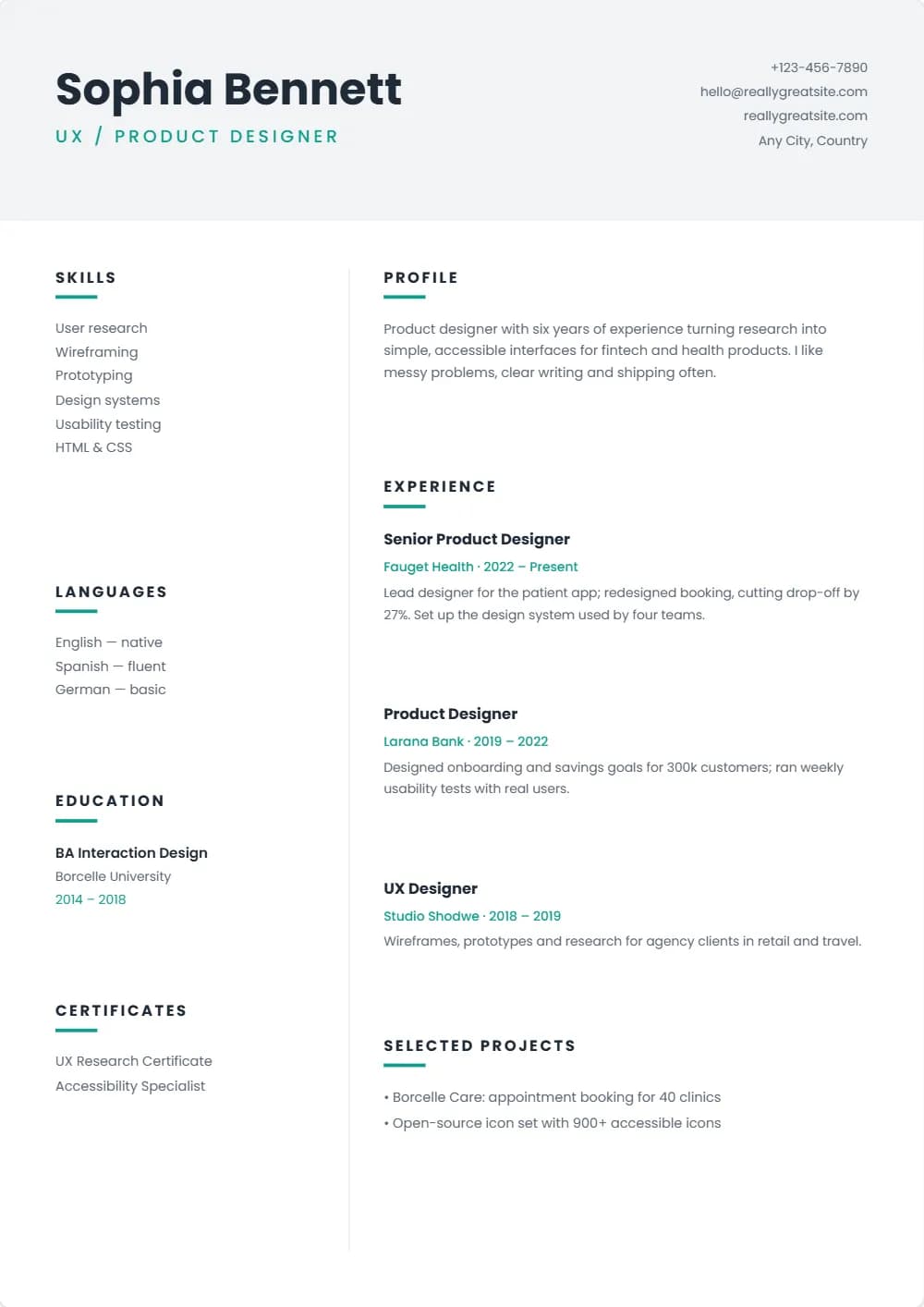 Modern Two-Column Resume
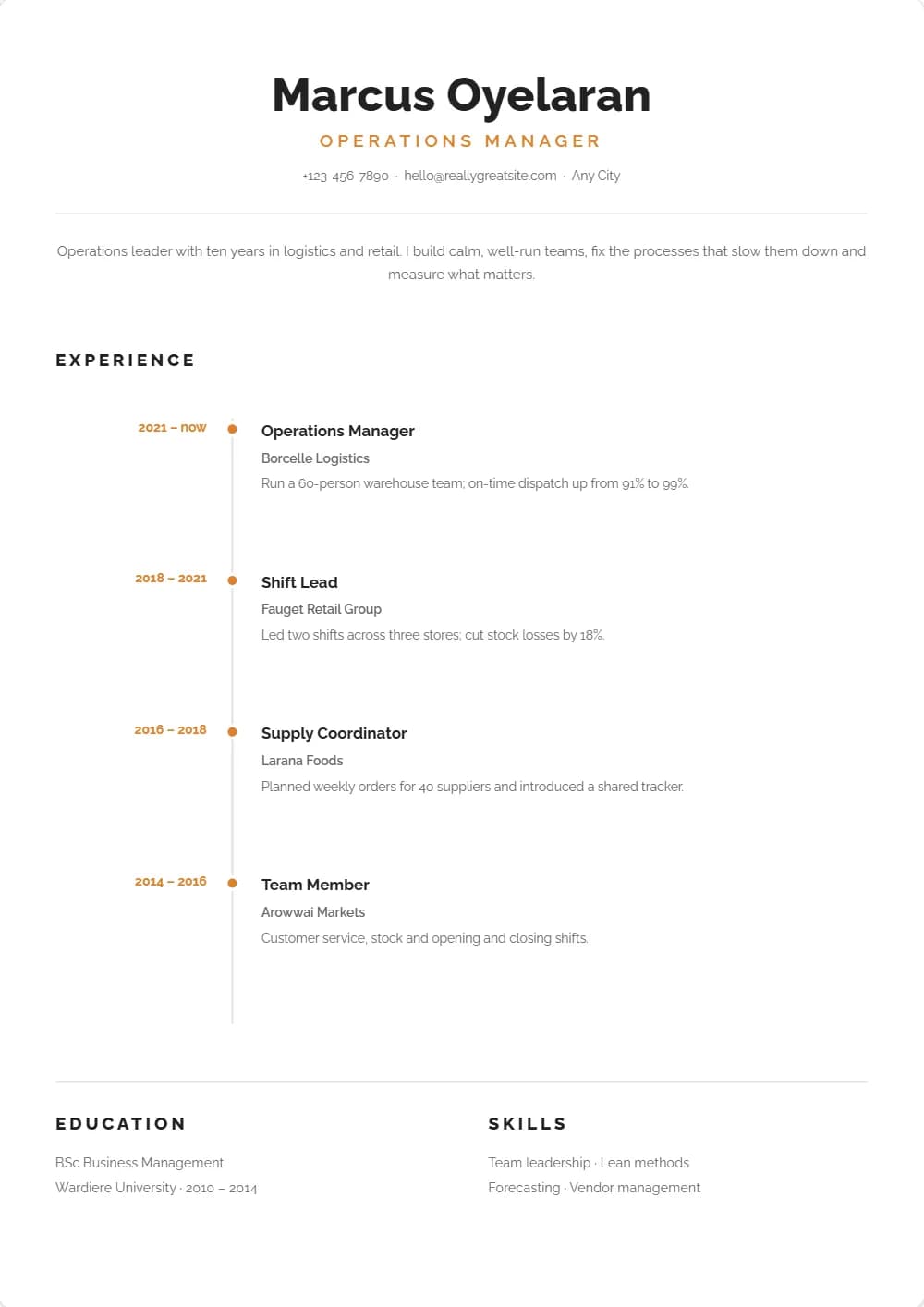 Timeline Resume
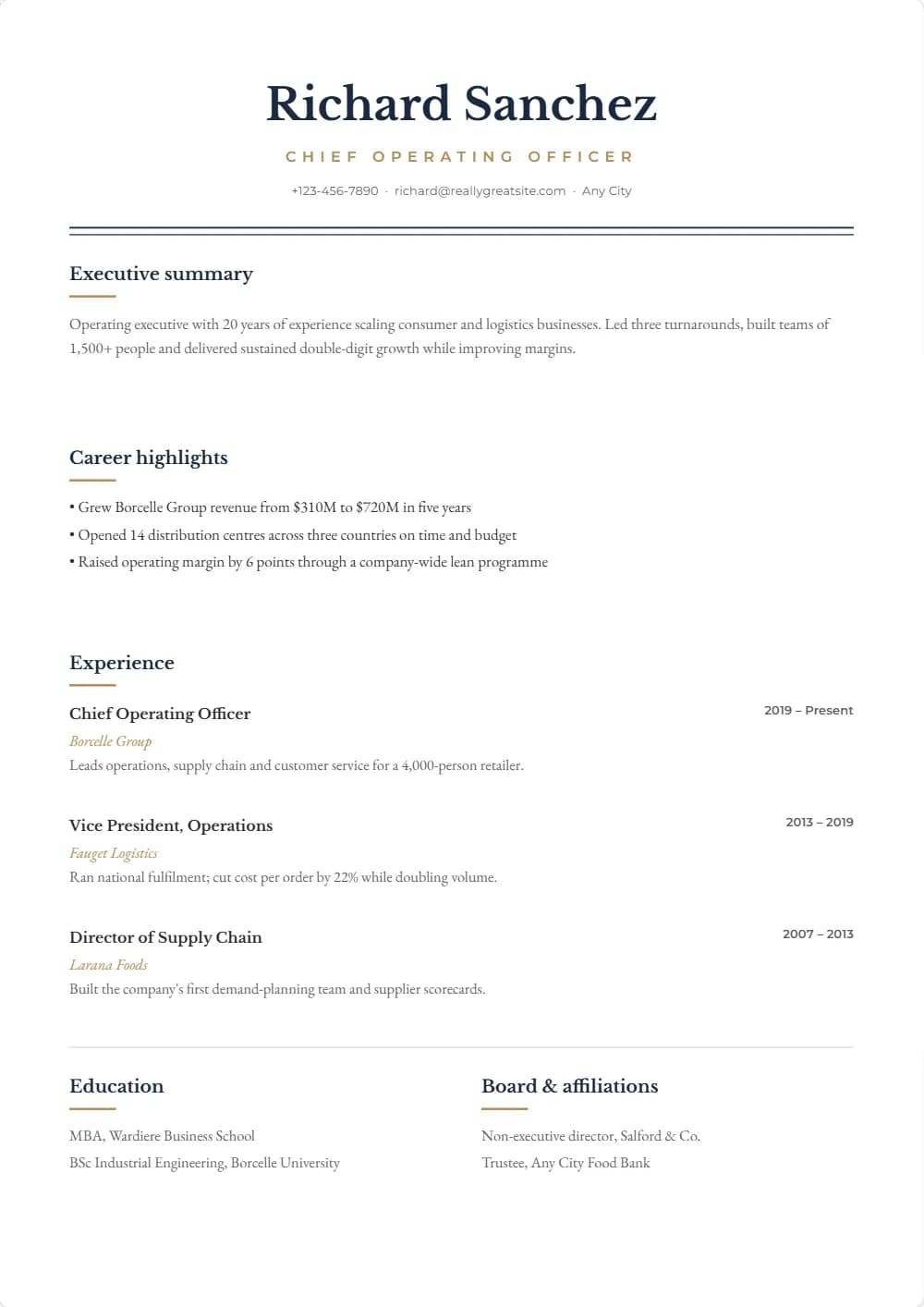 Executive Resume
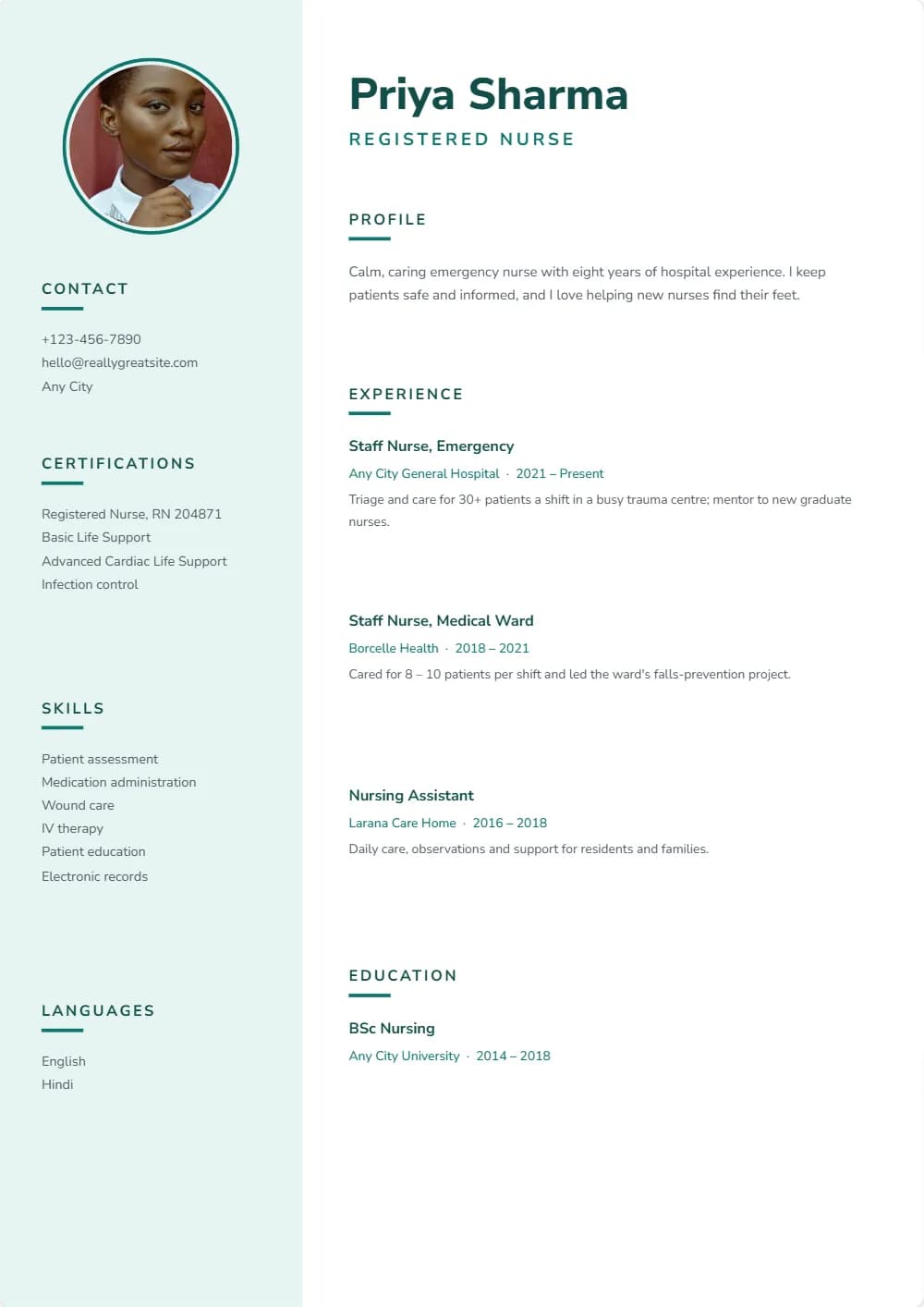 Nurse Resume
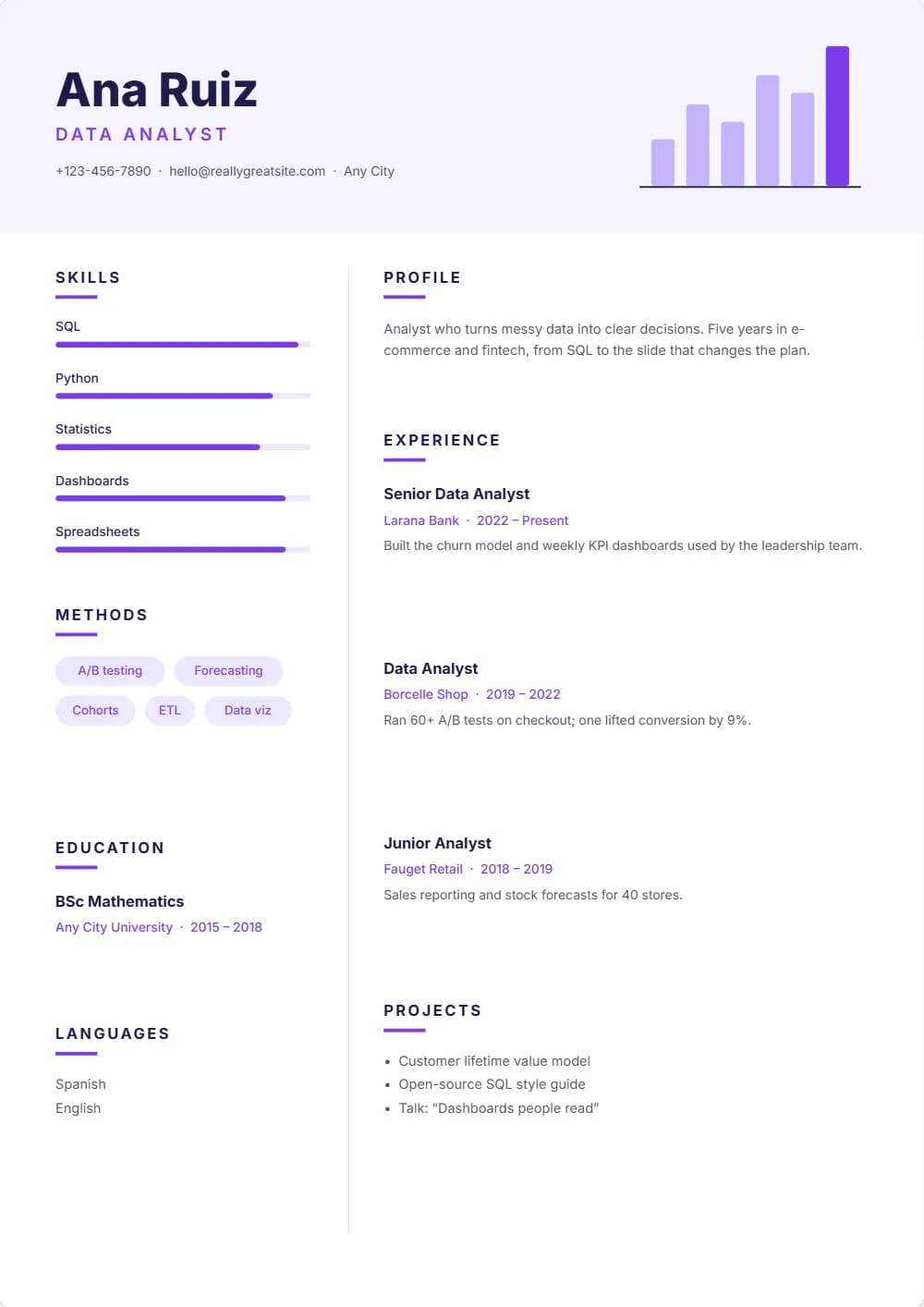 Data Analyst Resume
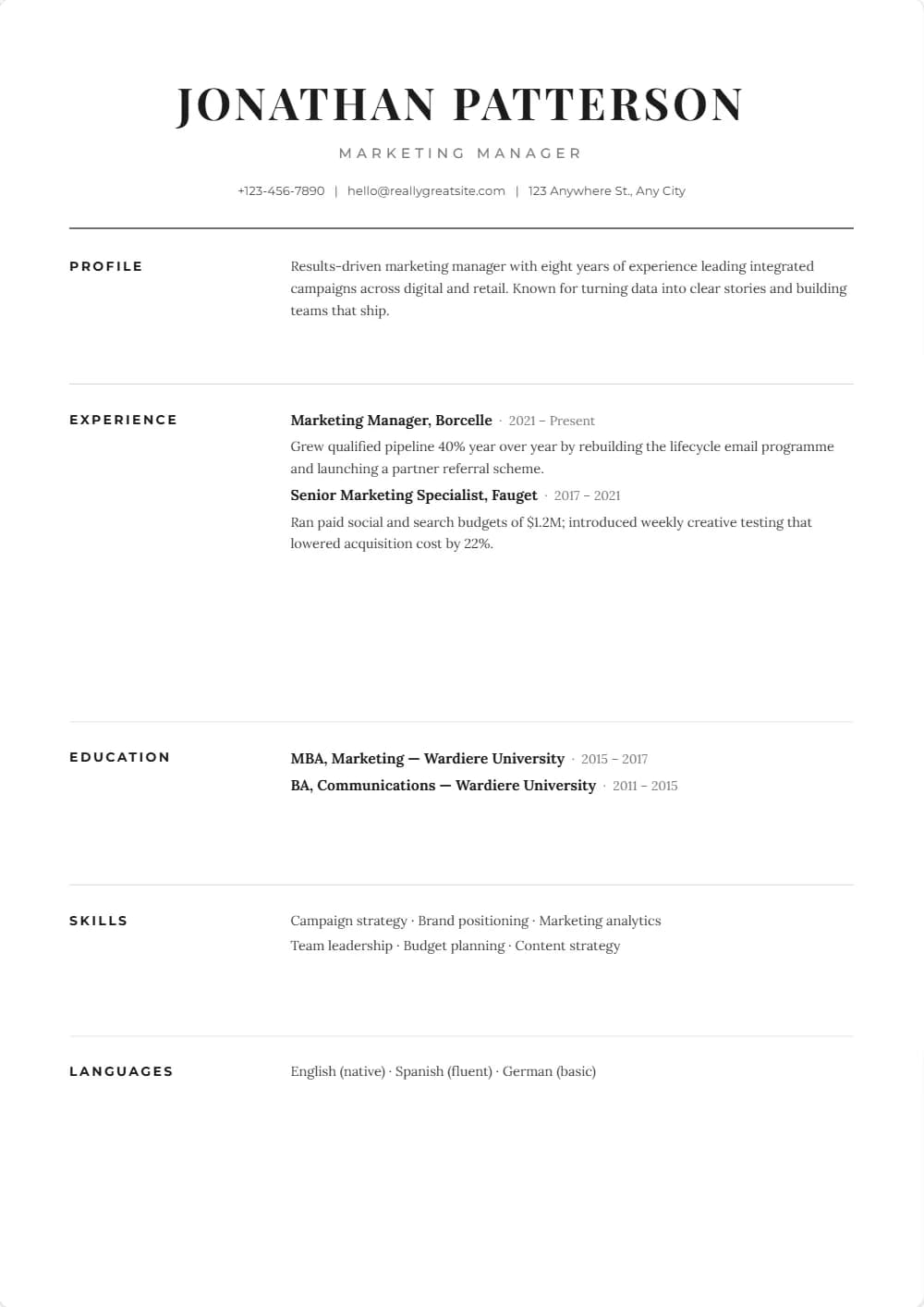 Classic Minimal Resume
With a free account, download a PDF whose text stays real, selectable text. Pair it with a tailored letter: the cover letter guide walks through one paragraph by paragraph.