
What a cover letter is for
Your resume lists what you have done. The cover letter connects it to what this employer needs. A recruiter reading it should come away with three answers: which job you are applying for, why you can do it, and why you want it here rather than anywhere.
That is also why a generic cover letter rarely helps. If the same letter could be sent to fifty companies without changing a word, it tells the reader nothing they couldn't get from your resume. A specific one, even a short one, shows that you read the job ad and thought about it.
Before you write: read the job ad twice
The job ad is your brief. Read it once for the overall picture, then again with a pen, and mark:
- The two or three requirements that seem to matter most: they are usually listed first or repeated.
- Words and phrases the employer uses to describe the work, so you can use the same ones.
- Anything about the team, the company or its customers that you genuinely find interesting.
- The name of the hiring manager, if it is given. If it isn't, the company's website or a professional networking profile often shows who leads the team.
For each requirement you marked, note one thing from your own experience that shows you can meet it. Those notes become the middle of your letter.
The layout of a cover letter
A cover letter follows the shape of a business letter and fits on one page. From top to bottom:
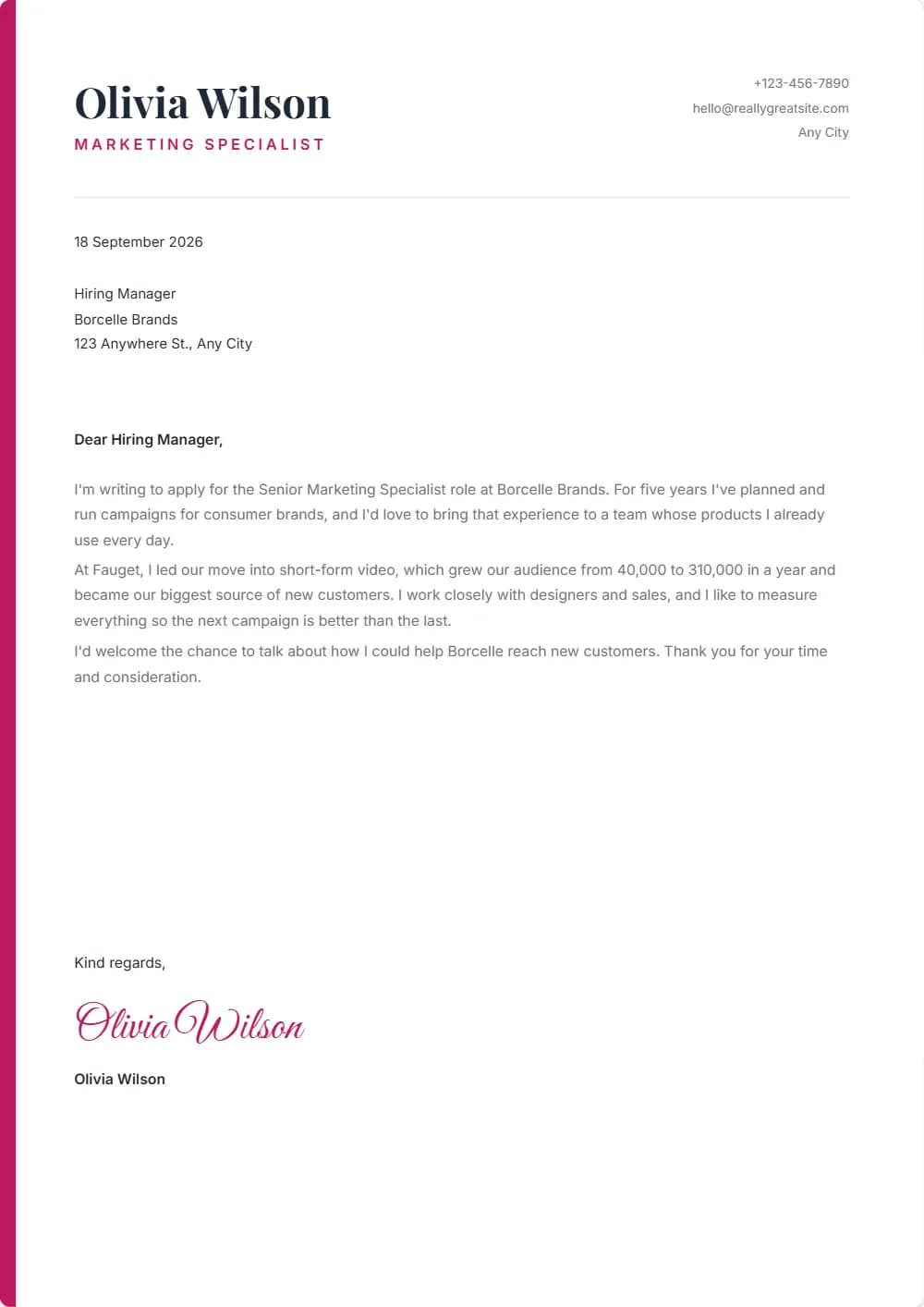
- Your name and contact details: phone, email, city, and a link to your portfolio or professional profile if you have one. Using the same header as your resume makes the two look like a set.
- The date.
- The employer's details: the hiring manager's name and title, the company and its city.
- A greeting: "Dear Ms Okafor," or, if you can't find a name, "Dear Hiring Manager,".
- Three or four short paragraphs: an opening, one or two on why you fit, and a closing.
- A sign-off: "Kind regards," or "Yours sincerely," followed by your name.
The opening paragraph
Say which job you are applying for and give one reason to keep reading. Avoid opening with "My name is…" (it's at the top already) or "I am writing to apply for…" on its own, which spends the most-read line of the letter on something the reader already knows.
I'd like to apply for the Customer Support Lead role at Bramblewick. For the past three years I've run the support inbox for a growing online shop, and I'd love to bring what I've learned to a team your size.
When I read that Elm Street Library is looking for a Community Events Assistant, I recognised the job I've been doing as a volunteer for two years: planning reading groups, booking speakers and getting the word out.
I'm a final-year accounting student applying for your graduate trainee programme. Your focus on small businesses is exactly why I chose accounting, and I'd welcome the chance to learn it with you.
The middle: show that you fit
This is the heart of the letter. Take the two or three requirements you marked in the job ad and, for each, give one short piece of evidence from your experience. Evidence means something that happened, ideally with a result: a project, a number, a problem you solved.
Claim: "I have excellent organisational skills."
Evidence: "Last year I organised our team's move to a new booking system, training eight colleagues and keeping every appointment running through the switch."
Claim: "I am passionate about customer service."
Evidence: "In my current role I answer around 60 customer emails a day, and our satisfaction score rose from 82% to 91% after I rewrote our standard replies."
You don't need to cover everything on your resume. Two well-chosen examples are more convincing than a list of ten skills, and they give an interviewer something to ask about.
Why this company
Many letters skip this, which is why it stands out when it's done well. In two or three sentences, say what draws you to this employer specifically: a product you use, a project you read about, the people it serves, the way it describes its team. Then connect it to yourself.
I've used Bramblewick's planner app for two years, and what keeps me coming back is how quickly your team answers questions. I'd like to help keep it that way as you grow.
Keep it honest and concrete. Praise that could apply to any company ("an industry leader with a great culture") reads as filler.
The closing paragraph
End by saying you'd welcome the chance to talk, and thank the reader for their time. One or two sentences is enough. Mention when you are available if it matters, for example if you are relocating or finishing a course.
I'd welcome the chance to talk about how I could help your team. Thank you for your time and consideration.
I'm available to start in June and would be glad to discuss the role at any time. Thank you for reading my application.
Tone, length and style
- Write as you would speak in an interview: polite, clear and natural. Avoid stiff phrases such as "Please find enclosed herewith".
- Use short paragraphs of two to four sentences. Recruiters skim.
- Match the company's tone. A law firm and a skate shop expect different letters, but both expect it to be easy to read.
- Use the same fonts as your resume, at a readable size of about 10 to 12 pt, so the two documents look like a set.
Common mistakes
- The wrong company name. It happens most when a letter is reused. Search the letter for every company name before sending.
- Repeating the resume line by line. Pick the evidence that matters for this job instead.
- Talking only about what you want. Your goals matter, but frame them around what you can do for the employer.
- Apologising for gaps. If you have a career break or little experience, focus on what you bring, not on what you lack.
- Spelling the hiring manager's name wrong. Check it against the source.
Applying by email or through a form
If you apply by email, the email itself can be a short version of your letter, with the full cover letter and your resume attached as PDFs. Name the files clearly, such as Amira-Khan-Cover-Letter.pdf. If the application form has a text box for a cover letter, paste in the text without the header and address lines, and keep the paragraph breaks.
Checklist before you send it
- The job title and company name are correct everywhere.
- It is addressed to a person, or to "Hiring Manager" if no name can be found.
- Each of the two or three main requirements has a piece of evidence.
- It says why this company, in your own words.
- It fits on one page and reads well aloud.
- It is saved as a PDF, and the file name includes your name.
Write your cover letter in Layquil
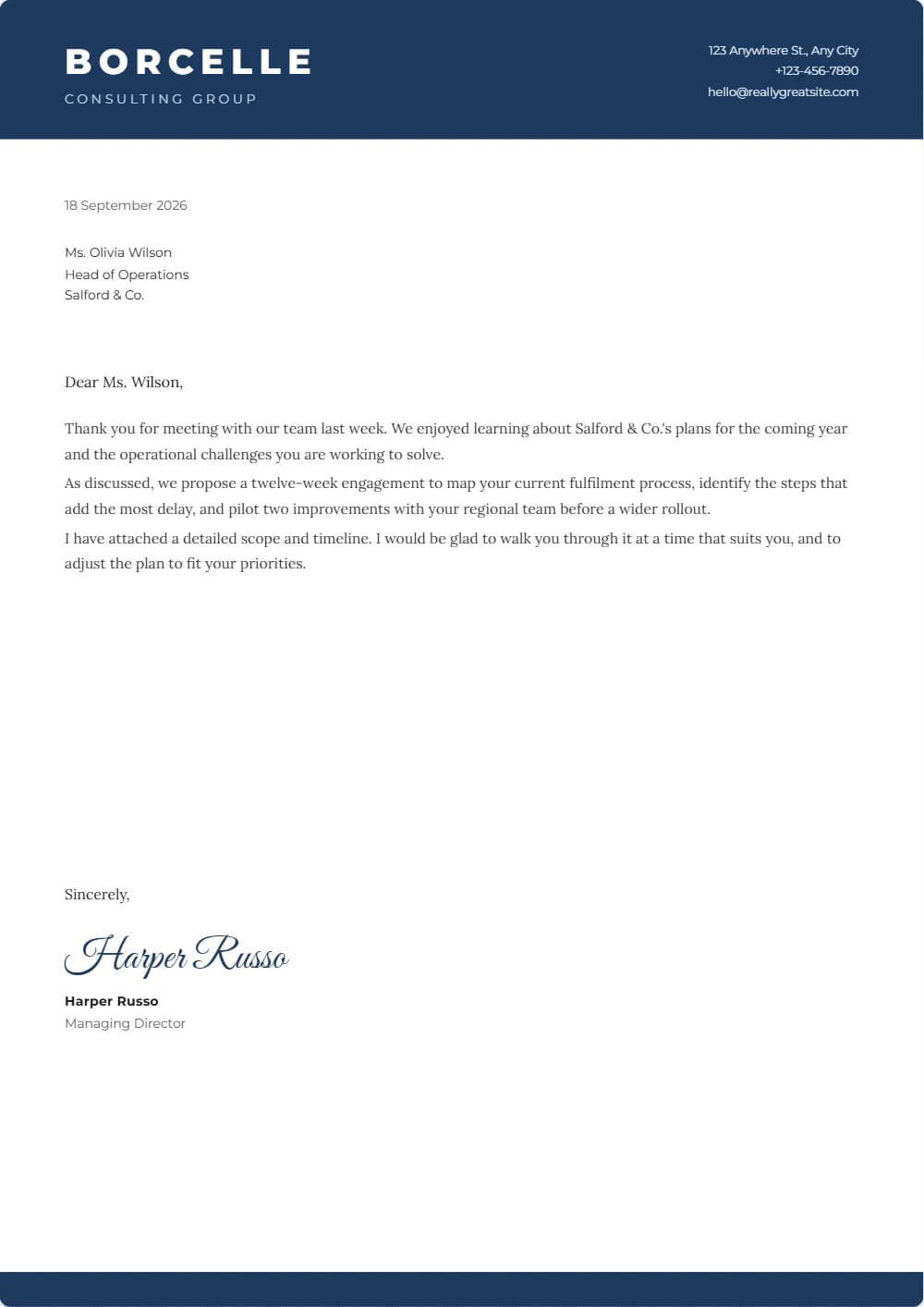
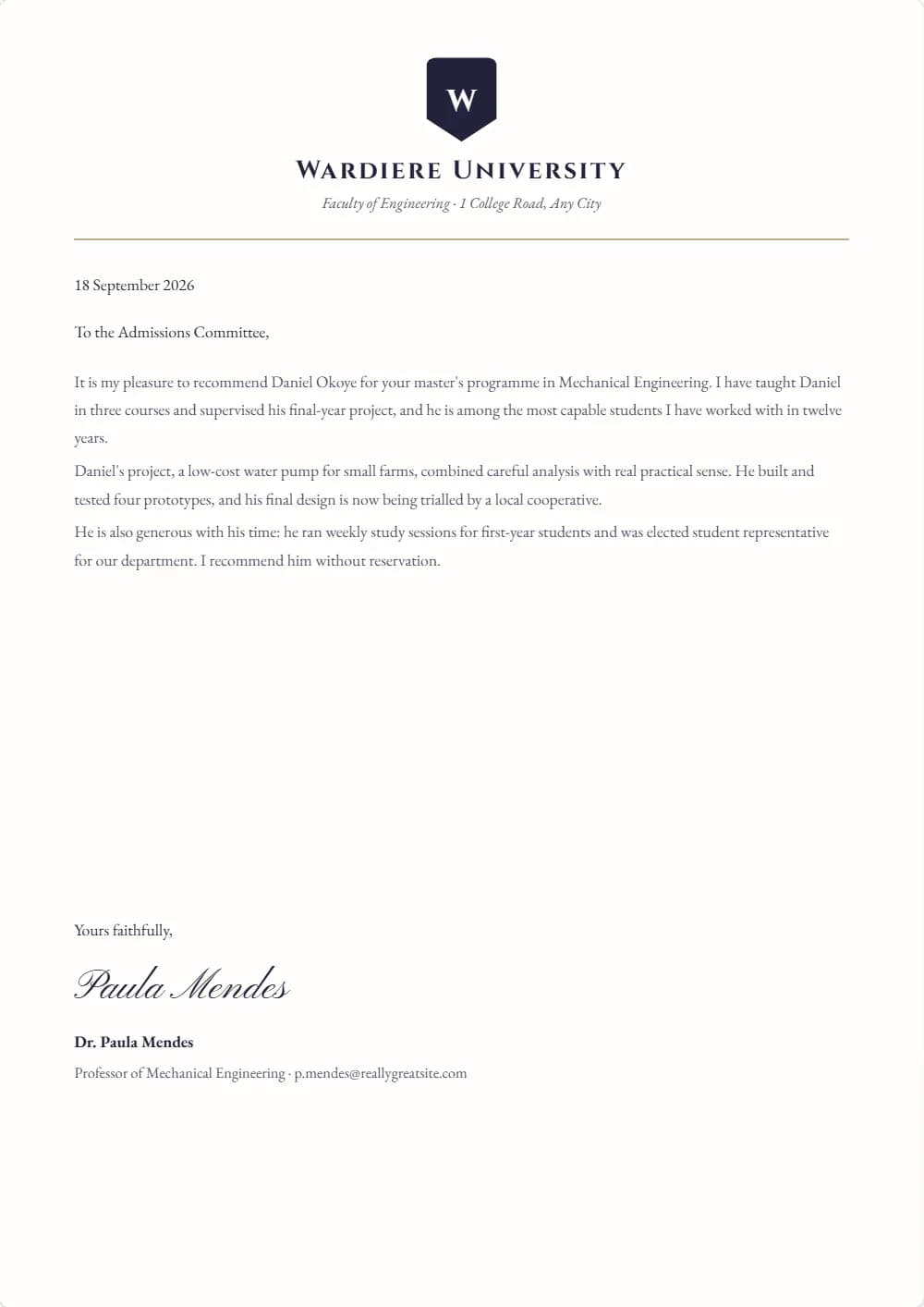
The Cover Letter template already follows the layout above: your name and job title as a header, contact details, the hiring manager's details, three short paragraphs and a signature. Open it from the document maker, click any text to replace it, and use the same fonts and colours as your resume so they match.
When it's ready, sign in with a free account and download a PDF. The text stays real text in the PDF, so it can be selected and searched. If you haven't made your resume yet, the resume with no experience guide walks through it.